Metal Oxide Varistors: Your Ultimate Guide to Overvoltage Protection
2025.01.27
Imagine a world where a sudden power surge could fry all your electronic devices. Thankfully, a small but mighty component, the metal oxide varistor (MOV), stands guard against such catastrophes. Like a tiny electrical bodyguard, the MOV absorbs excess voltage, protecting sensitive circuits from damage. This article will delve into the fascinating world of MOVs, exploring their function, applications, and how they contribute to the safety and reliability of modern electronics.
What is a Metal Oxide Varistor (MOV)?
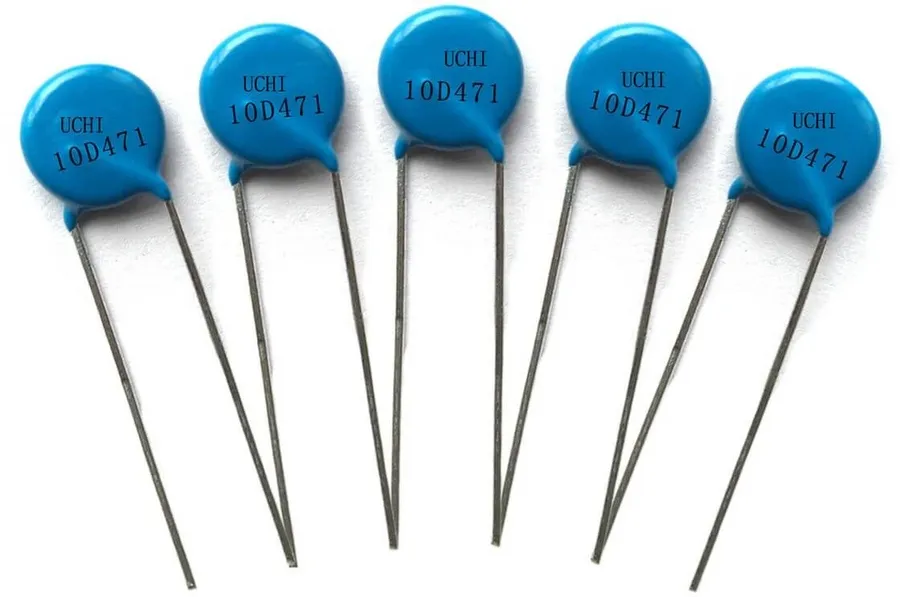
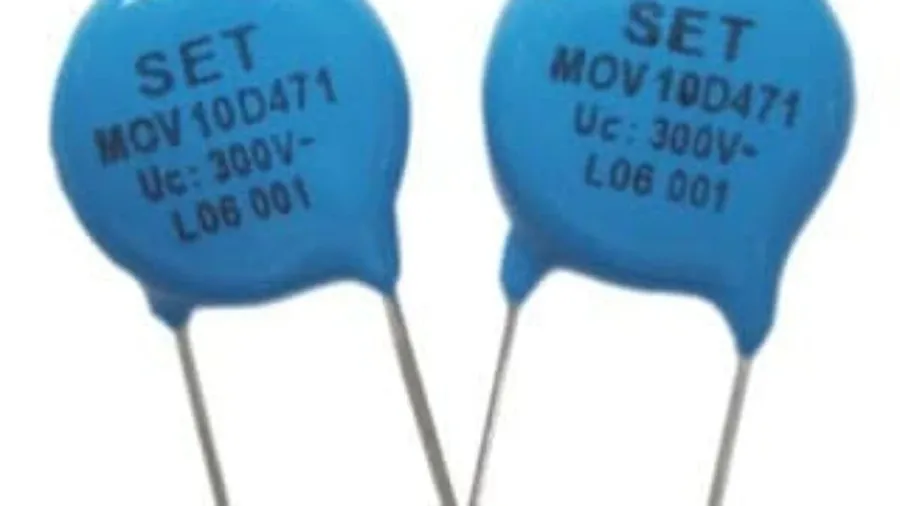
Metal Oxide Varistor
A Metal Oxide Varistor (MOV) is a voltage-dependent resistor, also known as a varistor, specifically engineered to safeguard electronic circuits from transient overvoltage events. Its core function lies in its capacity to drastically reduce its resistance when subjected to voltages exceeding its rated level, effectively diverting excess current and thereby preventing damage to sensitive downstream components. This behavior makes it a critical component in overvoltage protection.
How Does a Metal Oxide Varistor Work?
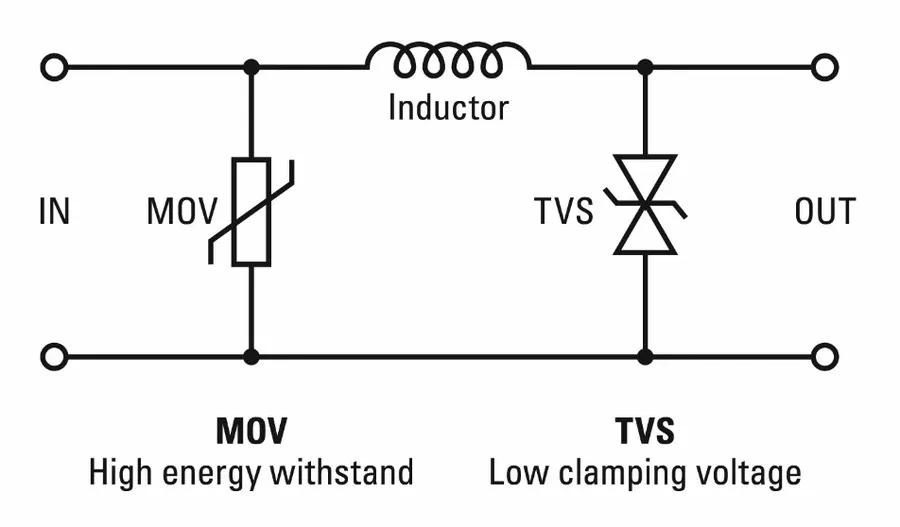
Varistor in Circuit
Metal Oxide Varistors (MOVs) function as voltage-dependent resistors, exhibiting a significant decrease in resistance when exposed to overvoltage conditions, thereby diverting excess current away from sensitive electronic components and safeguarding them from damage. This behavior is rooted in the MOV's unique microstructure and material properties.
At the heart of an MOV lies a ceramic matrix composed of zinc oxide (ZnO) grains interspersed with other metal oxides. These grains are separated by grain boundaries that act as insulating barriers under normal operating voltages. However, when a transient overvoltage occurs, exceeding the MOV's designed voltage threshold, a breakdown phenomenon occurs at these grain boundaries, drastically reducing the resistance across the device.
This reduction in resistance facilitates the flow of excess current through the MOV, effectively shunting it away from the protected circuit. Once the overvoltage subsides and the voltage returns to normal, the MOV's resistance automatically increases, returning it to its high-resistance, non-conductive state. This cycle of low and high resistance allows the MOV to protect the electronic circuit from repeated overvoltage events, albeit with a degradation effect over time.
Condition
MOV Resistance
Current Path
Circuit Status
Normal Voltage
High
Minimal current through MOV
Protected
Overvoltage
Low
Significant current shunted through MOV
Protected
Key Characteristics of Metal Oxide Varistors
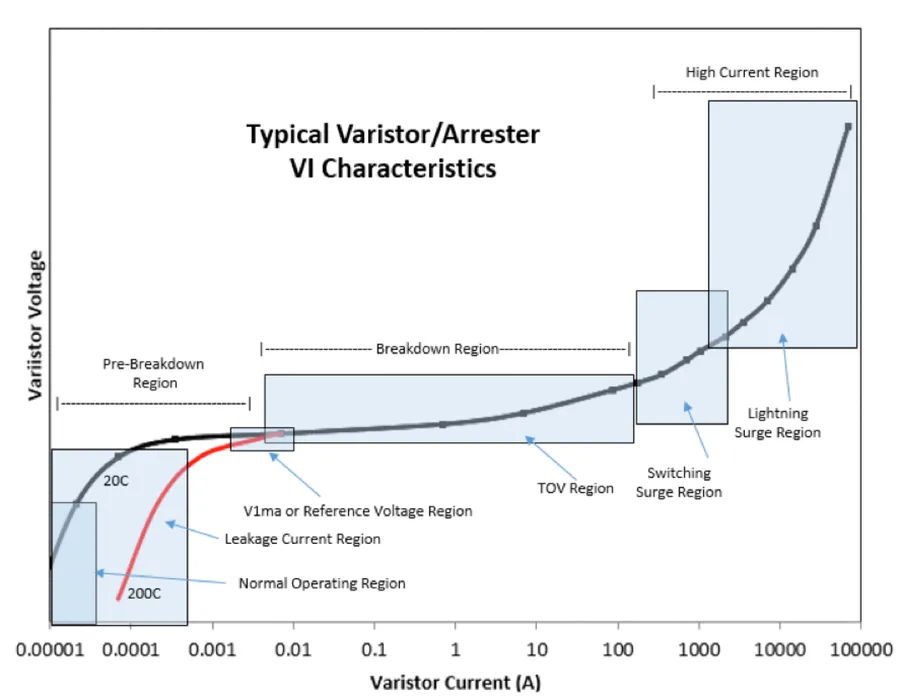
Varistor VI Curve
Metal Oxide Varistors (MOVs) are characterized by several critical parameters that determine their effectiveness in protecting circuits from overvoltage transients. Understanding these characteristics—voltage rating, current capacity, and response time—is essential for selecting the correct MOV for a given application, as they directly impact performance and reliability of the protection circuit.
Characteristic
Description
Impact on Performance
Voltage Rating
The maximum continuous voltage that the MOV can withstand without conducting significant current. Also includes the varistor voltage (also known as clamping voltage), at which the MOV begins to conduct and divert the surge current.
Determines the MOV's trigger point and the level of protection. Incorrect voltage rating may lead to premature failure or ineffective surge protection.
Current Capacity
The amount of current the MOV can handle during a surge event. Specified as peak pulse current, surge current, or energy handling capability. This capacity must be sufficient to safely absorb the surge energy without damage to the MOV.
Indicates how effectively the MOV can divert surge current. Inadequate capacity leads to overheating and MOV failure, causing the protected equipment to be exposed to the surge.
Response Time
The time it takes for the MOV to transition from a high-resistance to a low-resistance state when subjected to an overvoltage condition. This response needs to be sufficiently rapid to mitigate transient events.
Affects how quickly the MOV can begin protecting a circuit. A slow response time may not adequately protect the circuit from fast transient overvoltages.
Capacitance
The inherent capacitance associated with the MOV. This capacitance can influence high-frequency performance.
This can be important in high frequency circuits where capacitance could affect circuit stability. Lower capacitance MOVs can be beneficial in these situations.
Clamping Voltage
The voltage at which the MOV starts to conduct significantly during a surge event, effectively limiting the voltage across the protected circuit. It is typically expressed as a voltage at a specified current.
Specifies the maximum voltage that a protected component will experience. Lower clamping voltage usually provides better protection, but the clamping voltage and operating voltage must match the voltage characteristics of the equipment to be protected.
Metal Oxide Varistor (MOV) vs. Other Surge Protection Devices
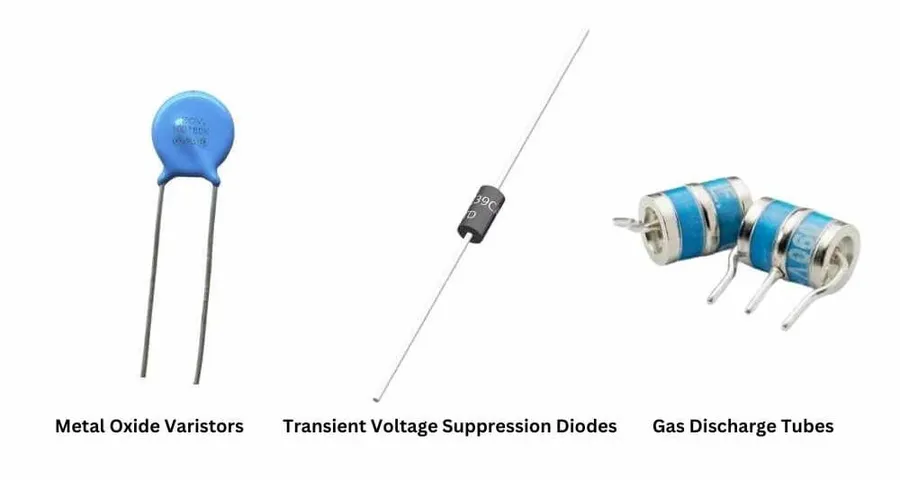
Varistor vs TVS
Metal Oxide Varistors (MOVs) are a prevalent choice for surge protection, but they are not the only option. This section provides a comparative analysis of MOVs against other common surge protection devices, namely Transient Voltage Suppression (TVS) diodes and Gas Discharge Tubes (GDTs), detailing the strengths and weaknesses of each to guide selection for specific applications.
Feature
MOV
TVS Diode
Gas Discharge Tube (GDT)
Response Time
Medium (nanoseconds)
Very Fast (picoseconds)
Slow (microseconds to milliseconds)
Clamping Voltage
Moderate to High
Low to Moderate, Precise
High, Less Precise
Current Capacity
High
Low to Moderate
Very High
Capacitance
Moderate to High
Low
Very Low
Durability/Lifespan
Degrades with each surge event
Very High, Minimal degradation
Long lifespan, but a limited number of surges
Cost
Low to Moderate
Moderate to High
Low
Typical Applications
Power supplies, general surge protection
Sensitive electronics, data lines
Telecommunications, power lines
MOVs excel in handling high surge currents and are cost-effective, making them suitable for general-purpose protection. TVS diodes, with their extremely fast response times and precise clamping voltages, are ideal for protecting sensitive electronic components. GDTs, on the other hand, are robust and can handle extremely high currents, making them appropriate for primary protection in high-power applications, though their slow response limits their use in sensitive circuits. The selection of a surge protection device should always be based on a thorough assessment of the specific needs of the protected circuit, accounting for the required response time, current handling capability, and the desired level of clamping voltage.
Applications of Metal Oxide Varistors
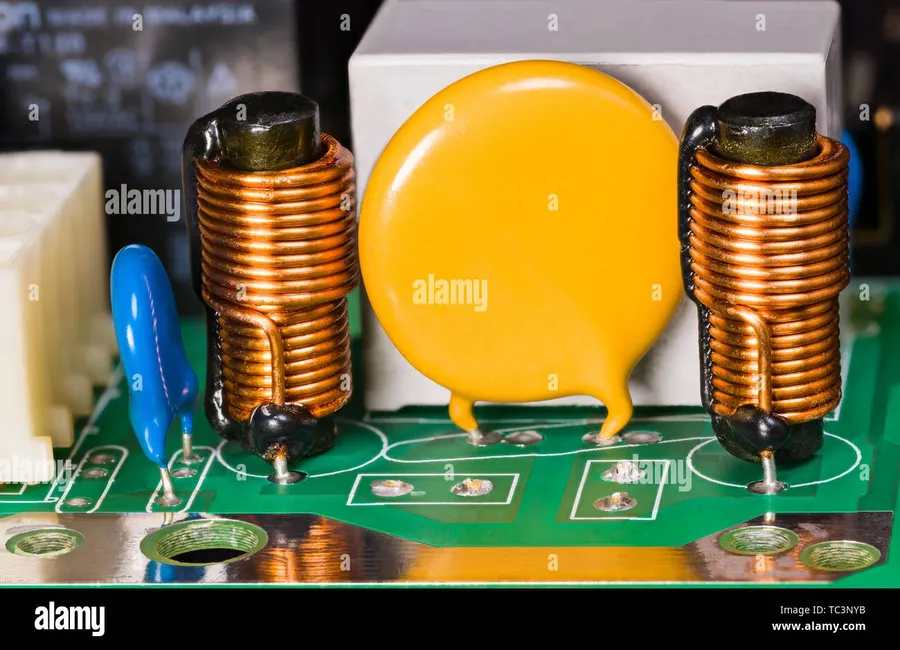
Varistor on Power Board
Metal oxide varistors (MOVs) are indispensable components for overvoltage protection across a multitude of industries, safeguarding sensitive electronics from damaging power surges and transient voltage spikes. Their ability to rapidly shunt excess current makes them a cornerstone of modern electronic system reliability.
Power Supplies and Distribution Systems MOVs are extensively used in AC and DC power supplies and distribution panels. They protect against lightning strikes, switching transients, and other power line disturbances that can damage connected equipment, enhancing the resilience of power grids and ensuring continuous operation of critical systems.
Automotive Electronics In vehicles, MOVs safeguard various electronic control units (ECUs), infotainment systems, and other sensitive automotive components from voltage fluctuations and transients generated by the vehicle's electrical system. This ensures the reliability of essential car systems, like airbags, engine control and advanced driver-assistance systems (ADAS).
Consumer Electronics MOVs are prevalent in everyday consumer devices such as televisions, computers, chargers, and appliances, offering protection against power surges that might otherwise lead to premature failure or malfunction. They contribute significantly to extending the lifespan of these devices and reducing consumer costs for repair or replacement.
Industrial Equipment Industrial applications of MOVs range from protecting manufacturing automation equipment to safeguarding sensitive sensors and control systems within factories. This protection is crucial to prevent costly downtime and maintain the integrity of manufacturing processes, enhancing operational efficiency and minimizing economic losses.
Telecommunications Infrastructure MOVs are essential for protecting sensitive telecommunications equipment, such as network servers, routers, and base stations, from power surges that could disrupt communication networks. They support the consistent and reliable operation of these crucial systems that support digital communication worldwide.
Renewable Energy Systems In solar panel installations and wind turbines, MOVs protect inverters and other critical components from voltage transients due to lightning strikes or grid disturbances, which is fundamental for the longevity and performance of renewable energy systems. This ensures clean energy production continuity.
Selecting the Right Metal Oxide Varistor
Varistor Selection
Selecting the correct metal oxide varistor (MOV) is critical for ensuring effective overvoltage protection and the longevity of your electronic circuits. This requires careful consideration of several factors, including the circuit's operating voltage, the expected transient energy, and the environmental conditions it will be exposed to.
Parameter
Description
Importance
Maximum Working Voltage (Vrms/Vdc)
The maximum continuous voltage the MOV can withstand without conducting.
Must be significantly above the normal operating voltage to prevent premature triggering and failure.
Clamping Voltage (Vc)
The voltage at which the MOV starts conducting significantly, limiting the voltage across the protected circuit.
Needs to be low enough to protect the circuit but high enough not to trigger under normal operating conditions.
Maximum Surge Current (Imax)
The peak current the MOV can handle for a short duration.
Must exceed the expected surge current; insufficient rating leads to MOV failure.
Energy Rating (Joules)
The amount of energy the MOV can absorb, defined as the product of clamping voltage and current over time.
Determines how much transient energy the MOV can dissipate. Insufficient rating can lead to MOV failure.
Response Time
The time it takes for the MOV to respond to an overvoltage event.
The MOV response time should be significantly faster than the rise time of the transient.
Operating Temperature
The range of ambient temperature where the MOV can operate safely.
Select an MOV rated for the intended operating temperature environment to avoid performance degradation or failure.
Physical Size and Mounting
The physical dimensions and mounting options of the MOV.
Ensure the MOV fits within the available space and can be properly mounted. PCB mount, axial leads, and radial leads are common options.
Circuit Voltage: Select a MOV with a maximum working voltage that is significantly higher than the normal operating voltage of the circuit to prevent premature activation and ensure reliable operation.
Transient Energy: Choose an MOV with an energy rating sufficient to handle the expected transient energy. Calculating or estimating the worst-case scenario for transient events is crucial.
Environmental Conditions: Consider the operating temperature range and humidity levels that the MOV will be exposed to and select components with adequate environmental ratings to maintain performance.
Response Time: Ensure that the MOV's response time is fast enough to protect against the speed of the surge. MOVs generally have a nanosecond response time, which is suitable for many applications.
Datasheet Analysis: Always refer to the MOV's datasheet. Parameters like clamping voltage, maximum surge current, and energy ratings are essential for ensuring proper component selection.
Frequently Asked Questions about Metal Oxide Varistors (MOVs)
This section addresses common inquiries regarding Metal Oxide Varistors (MOVs), clarifying their operation, constraints, and offering practical advice for troubleshooting and upkeep. These FAQs aim to resolve typical user uncertainties and offer comprehensive guidance on their usage.
What is the primary function of a metal oxide varistor? A metal oxide varistor (MOV) is primarily designed to protect electronic circuits from transient overvoltage events. It acts as a voltage-dependent resistor, changing its resistance to divert excess current away from sensitive components when a surge occurs.
What is the operational principle behind a MOV? The working principle of an MOV relies on its non-linear resistance characteristics. Under normal operating voltages, it exhibits high resistance. However, when exposed to an overvoltage, its resistance drops significantly, allowing the excess current to flow through the MOV and away from the protected circuit, thus preventing damage.
Is a varistor the same as a surge protector? While a varistor is a crucial component in many surge protectors, it is not the entire surge protection device. A surge protector often incorporates multiple components, including varistors, to effectively mitigate overvoltage. The varistor is the core element performing the voltage clamping function.
What are the limitations of a metal oxide varistor? MOVs have limitations, including a finite surge handling capacity and degradation over time due to repeated surge events. They are also known to have a response time, though typically it's very fast, and can fail in a short circuit condition. Therefore, they are not suitable for continuous overvoltage situations and must be appropriately rated for the application.
What does the voltage rating of an MOV signify? The voltage rating of an MOV specifies the maximum voltage the device can continuously withstand without triggering and becoming conductive. It should be higher than the normal operating voltage of the circuit it protects, and properly selected, it will not act on circuit voltages below this value. Exceeding this rated voltage will cause the MOV to start conducting.
How do I select an appropriate MOV for my circuit? Choosing the right MOV involves considering various parameters such as the maximum operating voltage of the protected circuit, the expected surge current, and the energy the MOV is expected to absorb during a surge. It's crucial to select a MOV with a voltage rating slightly higher than the maximum operating voltage of the circuit and an appropriate surge current rating to provide optimal protection. The datasheet will include the varistor voltage, clamping voltage, maximum peak current and energy ratings.
How can I troubleshoot a potentially faulty MOV? A faulty MOV can often be identified by physical damage, such as cracks or bulges, or by electrical testing using a multimeter. An MOV is typically considered faulty when there is a short circuit, an open circuit or a significant reduction in its resistance compared to a new component. If you suspect a faulty MOV, it's advisable to replace it with a new one of the same rating.
Metal Oxide Varistor Testing and Reliability
Ensuring the reliable operation of Metal Oxide Varistors (MOVs) requires rigorous testing and an understanding of their failure modes. This section details essential testing procedures, explores reliability considerations, and outlines maintenance practices to guarantee the long-term effectiveness of MOVs in circuit protection.
Standard Tests for MOVs Key tests include:
* **Varistor Voltage Test:** Measures the voltage at which the MOV starts to conduct significantly. This ensures the MOV is activated at the correct threshold.
* **Clamping Voltage Test:** Verifies the maximum voltage the MOV allows to pass during a surge. This is crucial for ensuring that sensitive components are not damaged.
* **Leakage Current Test:** Measures the small amount of current that flows through the MOV under normal operating conditions. A high leakage current can indicate degradation.
* **Surge Current Test:** Assesses the MOV's ability to withstand high surge currents. This is critical for protection during transient events.
* **Insulation Resistance Test**: Checks the insulation resistance of the MOV to prevent leakage to other components.
Reliability Factors of MOVs Factors affecting MOV reliability include:
* **Number and Severity of Surges:** MOVs degrade with each surge they handle, especially those near their maximum capacity.
* **Operating Temperature:** Excessive heat can accelerate MOV degradation and decrease its lifespan.
* **Environmental Conditions:** Exposure to moisture, corrosive substances, and other harsh elements can compromise their performance.
* **Manufacturing Quality:** Variations in manufacturing processes can lead to inconsistencies in MOV performance and reliability.
Common Failure Modes of MOVs The primary failure modes observed in MOVs are:
* **Short Circuit:** Occurs when the MOV fails and provides a low-resistance path, often due to excessive surge current, leading to system malfunction.
* **Open Circuit:** Results when the MOV's internal structure is damaged, causing it to stop functioning entirely. The MOV will no longer protect from overvoltage events.
* **Degradation:** Gradual loss of MOV's performance due to repeated surges, reduced clamping voltage, and increased leakage current, resulting in diminished protection capacity.
* **Thermal Runaway:** Excessive heat generation in an MOV resulting from surge current leading to a cascading failure. This can result in a fire risk.
MOV Maintenance and Replacement Guidelines Routine checks and maintenance help prevent failures and maintain proper operation of MOVs.
* **Visual Inspection:** Look for signs of physical damage like cracks, discoloration, or swelling that may indicate potential failures.
* **Regular Testing:** Periodically test MOVs with a multimeter to identify degradation and ensure they still meet specified performance criteria.
* **Preventative Replacement:** Replace MOVs proactively, especially in high-risk applications or after repeated surges, or based on the manufacturer’s replacement guidelines.
* **Proper Storage:** Keep MOVs in a dry, cool environment to prevent pre-mature degradation before being deployed in an application.
Future Trends in Metal Oxide Varistor Technology
The field of metal oxide varistor (MOV) technology is continuously evolving, driven by the need for more efficient, reliable, and compact overvoltage protection solutions. Future advancements focus on enhancing energy handling capabilities, reducing response times, and miniaturizing device size. These trends are heavily influenced by ongoing innovations in material science.
Enhanced Energy Handling Capabilities Research is underway to develop MOV materials and designs that can absorb and dissipate greater amounts of transient energy without degradation. This involves exploring new material compositions and fabrication techniques that improve the varistor's nonlinear characteristics and thermal stability, allowing them to endure more intense surges and contributing to a longer lifespan.
Faster Response Times Reducing the response time of MOVs is critical for protecting sensitive electronic components from fast-rising transient overvoltages. Advanced materials and nano-fabrication methods are being used to achieve quicker responses, enabling MOVs to clamp the voltage spike faster and more effectively, thereby minimizing the potential damage. The goal is to reduce the time it takes for the MOV to transition from a high-resistance to low-resistance state when an overvoltage condition occurs, which is critical to protect sensitive circuitry from damage.
Miniaturization With the increasing miniaturization of electronic devices, there is a corresponding need for smaller MOVs with equivalent performance. Researchers are actively exploring novel materials and manufacturing processes that allow for the production of more compact MOVs without compromising their electrical characteristics. This involves innovations in material processing and deposition techniques, focusing on creating smaller granular structures, leading to higher performance and smaller form factor of MOVs.
Advanced Materials and Nanotechnology The use of nanomaterials and advanced doping techniques are being investigated to optimize the electrical and mechanical properties of MOVs. Nanotechnology allows for precise control of material composition and microstructure, potentially leading to significant improvements in the performance and reliability of MOVs. These advancements could include improvements in the varistor’s nonlinear coefficient, breakdown voltage accuracy, and energy dissipation efficiency.
Integration with other components Efforts are being made to integrate MOVs with other electronic components within single package solutions. This can lead to more compact, efficient, and cost-effective circuit designs. Integration of MOVs with other components like TVS diodes and filter circuits to provide more effective and complex protection is a emerging trend, providing a more complete protection solution in a smaller footprint.
Smart MOVs The development of 'smart' MOVs with embedded sensing capabilities is an area of research. These devices can monitor their own status and performance, providing valuable data for predictive maintenance and enabling system-level diagnostics. Such smart capabilities would enable better monitoring of a device's condition, which in turn will help prevent failures before they occur and allow for the timely replacement of an aging MOV, further enhancing system reliability.
Metal oxide varistors are essential components that play a vital role in safeguarding electronic devices from overvoltage damage. By understanding their working principles, applications, and selection criteria, you can ensure the reliability and longevity of your valuable electronics. From simple home appliances to complex industrial systems, the MOV stands as a silent guardian, protecting the electronic world we depend on. Continued advancements promise even more robust and efficient MOVs in the future, securing a safer and more reliable world.